A common question with the 600 is how to manage sleep. It’s the first time you’ve got to deal with this — sleeping, or being sleep-deprived should be a non-issue on the shorter rides.
Most people tend to do one of three things for rest on the 600K:
(1) Ride straight through with no sleep. I’ll just put it right out there and say that I think this sucks, but some prefer it. I did it on my first 600K and was like, “Never doing that again.” Miserable and hot and tired and in a fog and just wanted to be done with the ride. What can I say? I’m soft and like my beauty rest.
That said, if you’re absolutely flying, you can clip off 600K, especially given our relatively flat terrain, before the sleep monster stirs. Despite swearing it off, I banged out 600K on the front end of a 1200K once in just under 26 hours (it was flat and I had a tailwind and two very strong riders to help set pace). The fastest 600s in Florida have been done somewhere between 24 and 27 hours. (Still waiting on someone to break the 24-hour barrier here.) If you’re so fast, and so inclined, that riding a 600K within the 400K time limit is your plan, then sleep isn’t really an issue. Sleep when you’re done.
On the other end of the spectrum, the slowest among us effectively don’t have any choice but to ride the 600K straight through. They won’t have the luxury of taking any significant pause, lest they risk running out of time. If this is you, keep moving as best you can and hope for some short rests or cat-naps, if not real sleep, if you can get it on the route. Convenience stores, post office lobbies. The popular “ditch nap” is a no-go in most of our terrain, unless you have a special fondness for swamp water, cottonmouths, gators and mosquitos. Especially after today’s rain, our ditches are wet.
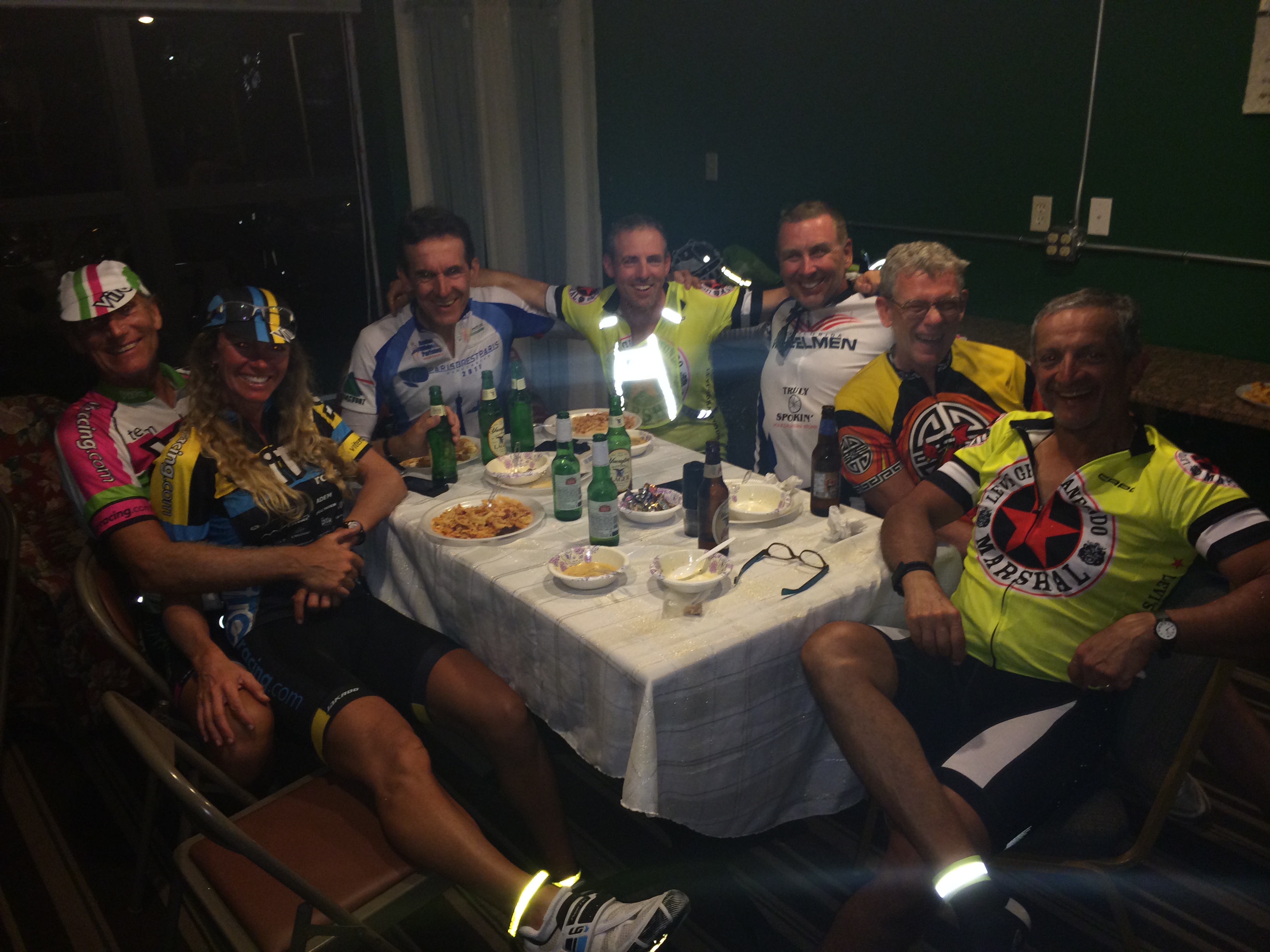
(2) Plan on stopping at some pre-determined point. On our 600K this year, the most obvious one would be the 400km mark, where we return to the same location you would have started at. Get some sleep. Ride 200km the next day. This is what I usually do, though it doesn’t by any means make it “right.” I typically get a hotel room and find folks to share with — either getting the reservation myself or hooking up with someone who already has one. You could try using the Facebook page for the group to manage that. Or I’ve even managed it on the day of the ride itself — both securing a room and also giving someone in need bed or floor space in a room I already had arranged. Another possibility, if you don’t want to get a hotel room, would be to sack out in your car for a few hours…. not an unusual strategy.
(3) Plan on stopping for a bit of a sleep, but without a predetermined stopping point. Folks taking this route typically are traveling “tourist” style with at least some extra clothes or a compact bivy sack with them so that they can take shelter somewhere on the route. Post office lobbies tend not to be locked at night, and I’ve slept in more than one of ‘em. I once saw a guy crammed into a phone booth (back in the days when such things existed). Isn’t much limit to what can serve as shelter when you’re tired and in need. The issue with this strategy on this year’s 600K route is that once you get past Clermont, there isn’t jack-squat until you get to Polk City other than road-side ditches in the middle of the Green Swamp, which as noted above isn’t going to be terribly comfortable. If you want significant rest — something more than you’re going to get in a convenience store — then the 400K point is your best bet for getting it on this ride.
Typically the “I’m going to stop and sleep, but I don’t know where” strategy is seen on 1200s, and especially on PBP where riders have three good options for stopping on the first day (roughly 360, 450, and 500km). The Shenandoah 1200K similarly offers several good stopping points at the end of the first day of riding, and riders on the Gold Rush this summer likewise have a choice (sleep in Susanville at all, or not?). There might be loop-style 600s that give riders options, too, of where to bunk for the night.
Keep in mind that with the second and third options, you’ll need to make sure that you calculate the time by when you need to leave your “sleep” stop by so that you can make it to the next control before it closes (using whatever margin of error you’re comfortable with). For example, if you stop at 400km to sleep, getting in at midnight, and the next control is 30 miles away and closes at 8am, then you might want to be on the road by no later than 5am. That’d give you 5 hours to get cleaned up, eat (probably twice), and sleep before you leave, which realistically means in this hypothetical that you’re going to get 3 hours of sleep. Of course, you can use the closing time of the overnight control as a rough proxy to guide you — so long as you leave by its closing time, then you ought to make it to the next control within the time limit. Most people, I find, tend to give themselves more of a margin of error (either to be safe or because they want a faster finish time). Don’t panic if you leave after the closing time, though. That might especially be a viable strategy on the 600K this year, where the next control is 60 miles down the road — you should be able to “make up” some time, if you need to.
A final word on departure time on Day 2 is remember to figure in the weather. Winds tend to be light at night, so you might want to give yourself a few hours of riding without the wind in your face. You also won’t have afternoon thunderstorms, searing heat, and ridiculous humidity to deal with if you make an early departure.